Self-directed UX case study

FS.dk

Making furniture exchange simple, local and reliable.

A self-directed UX case study exploring how clearer pickup coordination can make furniture exchanges between neighbors easier and more reliable.

Role
UX Research · Product Design · Prototyping
Timeline
8 weeks
Type
Self-directed UX study
Industry
Marketplace · Consumer
Tools
Figma · FigJam
Location
Copenhagen, Denmark

This project validates a product concept through research and prototyping rather than implementation.

02The problem

Users don't struggle to find furniture. They struggle to coordinate pickups.

On existing platforms, people write a lot of messages just to agree on a time. Availability is unclear, plans change and pickups get cancelled at the last minute.

The result is wasted time and abandoned exchanges, even when both people really wanted the swap to happen.

03Research & Discovery

Listening before designing.

I interviewed people in Copenhagen, both locals and expats, who had recently given away or picked up furniture, to understand how the process really works and where it breaks.

5

Participants, locals and expats

30–45

Minutes per interview

CPH

Copenhagen area

01

Coordination

Coordination is the hard part.

People spend more time agreeing on a pickup than looking for items.

02

Trust

Trust between strangers is fragile.

People want some context about the other person before meeting.

03

Reliability

One bad experience is enough.

After a no-show, most people stop using the platform.

04

Simplicity

Clarity beats more features.

Knowing the next step matters more than extra functionality.

From interviews to insights

Turning interviews into design decisions.

I spoke with five people who regularly use Facebook Marketplace, DBA and local exchange groups. I grouped the conversations around the problems that appeared repeatedly: trust, coordination and pickup reliability. These patterns helped define which part of the exchange was worth redesigning.

  1. 01

    5 interviews

    Semi-structured, 30 to 45 min.

  2. 02

    Common frustrations

    Grouped by what people repeated.

  3. 03

    Recurring patterns

    Trust, coordination, reliability.

  4. 04

    Design decisions

    What was worth redesigning.

04Personas

Two users, one shared frustration.

One wants speed, the other wants to help her community, but both get stuck in the same place: agreeing on a pickup.

Lucas, 32

Lucas, 32

Recently moved to Copenhagen

Argentinian event producer living alone in Copenhagen. He changes his space often and gives away furniture through community platforms.

Goals

  • Give away furniture quickly and easily.
  • Find people who actually show up.
  • Keep the process simple and predictable.

Pain points

  • People say they will come but never arrive.
  • Too much messaging to agree on a time.
  • Last minute cancellations.

Behaviors

  • Posts on Marketplace and FreeYourStuff every week.
  • Works irregular hours, so he needs flexible times.
  • Gives up on an exchange after one no-show.
  • Prefers choosing a time directly instead of coordinating through messages.
Mette, 45

Mette, 45

Lives in Frederiksberg with her family

Government employee in Frederiksberg, married with two teenagers. She often gives away items so they get reused instead of thrown away.

Goals

  • Give things away without extra effort.
  • Help others through reuse.
  • Avoid repeating the same conversation.

Pain points

  • Too many messages with the same questions.
  • People do not read the listing carefully.
  • It is unclear what the other person expects.

Behaviors

  • Writes a complete listing from the start.
  • Likes short and polite exchanges.
  • Stops replying when the chat gets long.
  • Trusts platforms where reliable people are visible.
05Key decisions

The product decisions that shaped the solution.

These are the choices that had the biggest impact on the direction of the product. Each one comes from something I heard in research.

  1. 01Decision

    Make scheduling part of the product

    Interviews showed that coordination, not discovery, was the hard part. Letting people pick a pickup day and time inside the flow removes most of the messaging.

  2. 02Decision

    Keep listing creation short

    People gave up when a listing asked for too much detail. A short first step with an optional second step keeps publishing quick while still giving buyers what they need.

  3. 03Decision

    Trust before speed

    Exchanges between neighbors depend on small signals. Clear profiles, mutual confirmation and visible status mattered more than faster matching.

  4. 04Decision

    Show only what is needed

    Each screen focuses on one decision. Pickup, address and confirmation details appear when they actually matter.

  5. 05Decision

    Start local

    The concept stays within a walkable area instead of scaling nationally. That keeps pickups realistic and matches how people already behave.

06Design opportunity

How might we?

How might we help neighbors coordinate furniture exchanges with less messaging, clearer plans and more trust?

Design principles

01

Make scheduling easier

Choose a pickup window instead of negotiating through chat.

02

Make plans clear

Both people should know exactly what has been agreed.

03

Reduce uncertainty

Show clear states before and after the pickup.

04

Create trust signals

Use profiles, completed exchanges and ratings.

07User journey

From finding an item to completing the exchange.

Instead of coordinating every detail through messages, the flow guides both people through a clear sequence from pickup selection to completion and feedback.

  1. 01

    Discover Item

  2. 02

    Review Listing

  3. 03

    Choose Pickup Time

  4. 04

    Confirm Exchange

  5. 05

    Complete Pickup

  6. 06

    Leave Feedback

Browsing and listings stay familiar. What changes is that scheduling, confirmation and feedback happen inside the product, which is exactly where most exchanges fall apart today.

08Constraints

What shaped and limited the solution.

The constraints mattered as much as the opportunities. They defined what was realistic to design and where the solution had to stay focused.

No usability testing
I could not run formal testing, so the decisions are based on interviews, secondary research and similar products.
Community marketplace
This is a neighbor to neighbor context, so heavy verification or payment flows did not fit.
Pickups happen in person
Time and location had to be part of the main flow instead of something people sort out later.
Trust between strangers
A new product has no long rating history, so trust had to come from small and simple signals.
Self-directed project
There was no client brief, so I set the scope myself and went deep on a few flows instead of covering everything.
09Final solution

Clear coordination instead of negotiation.

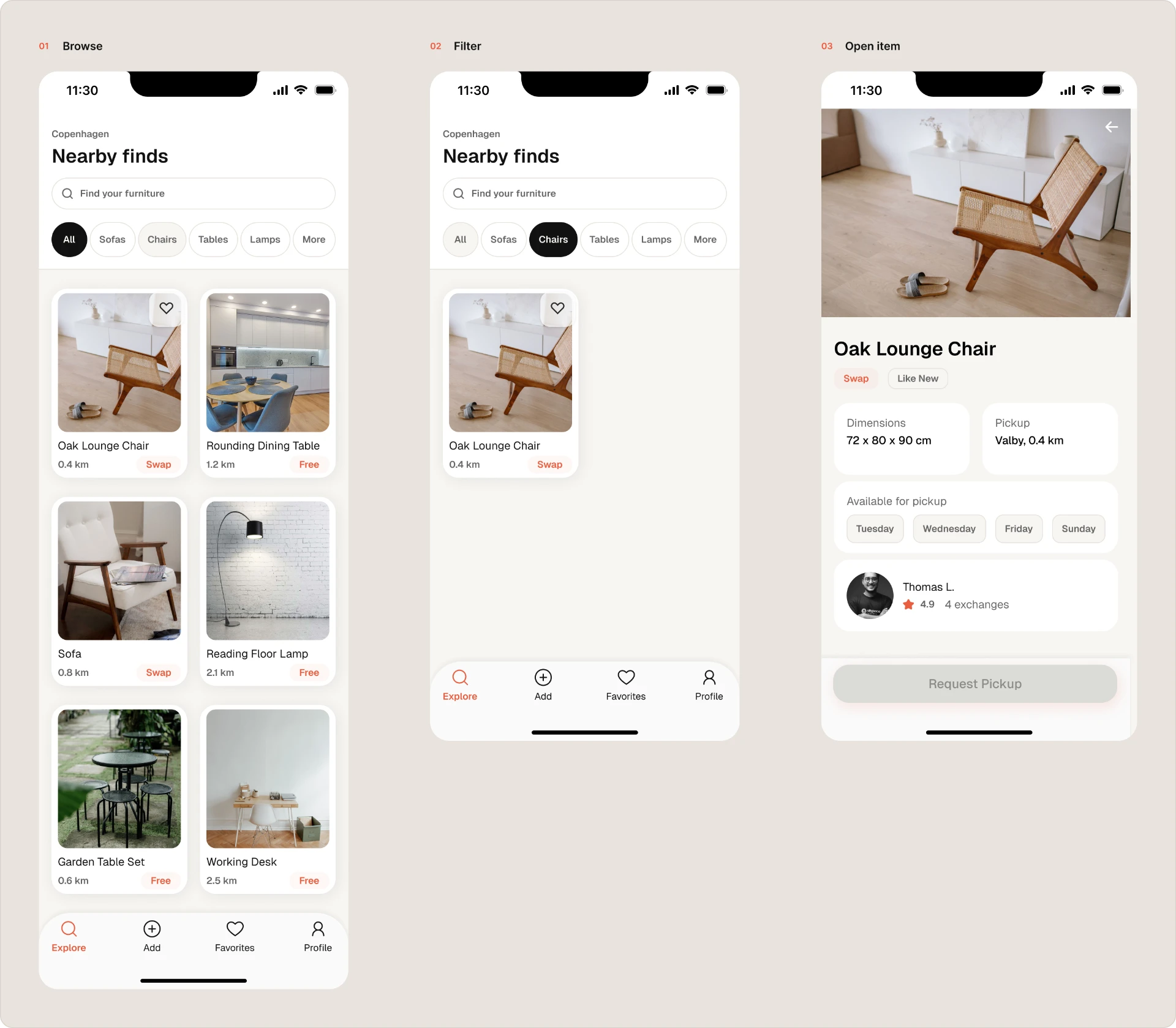
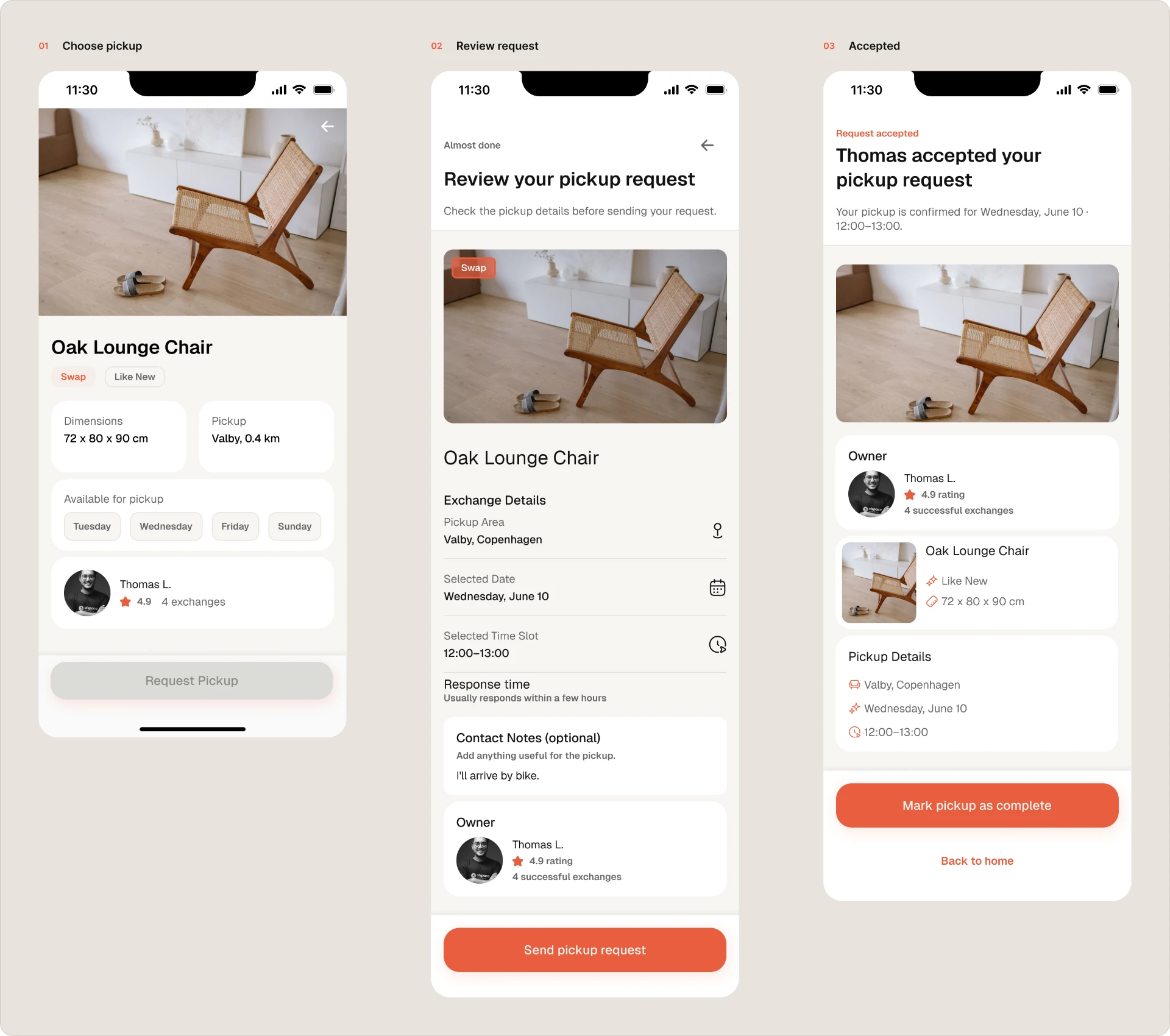
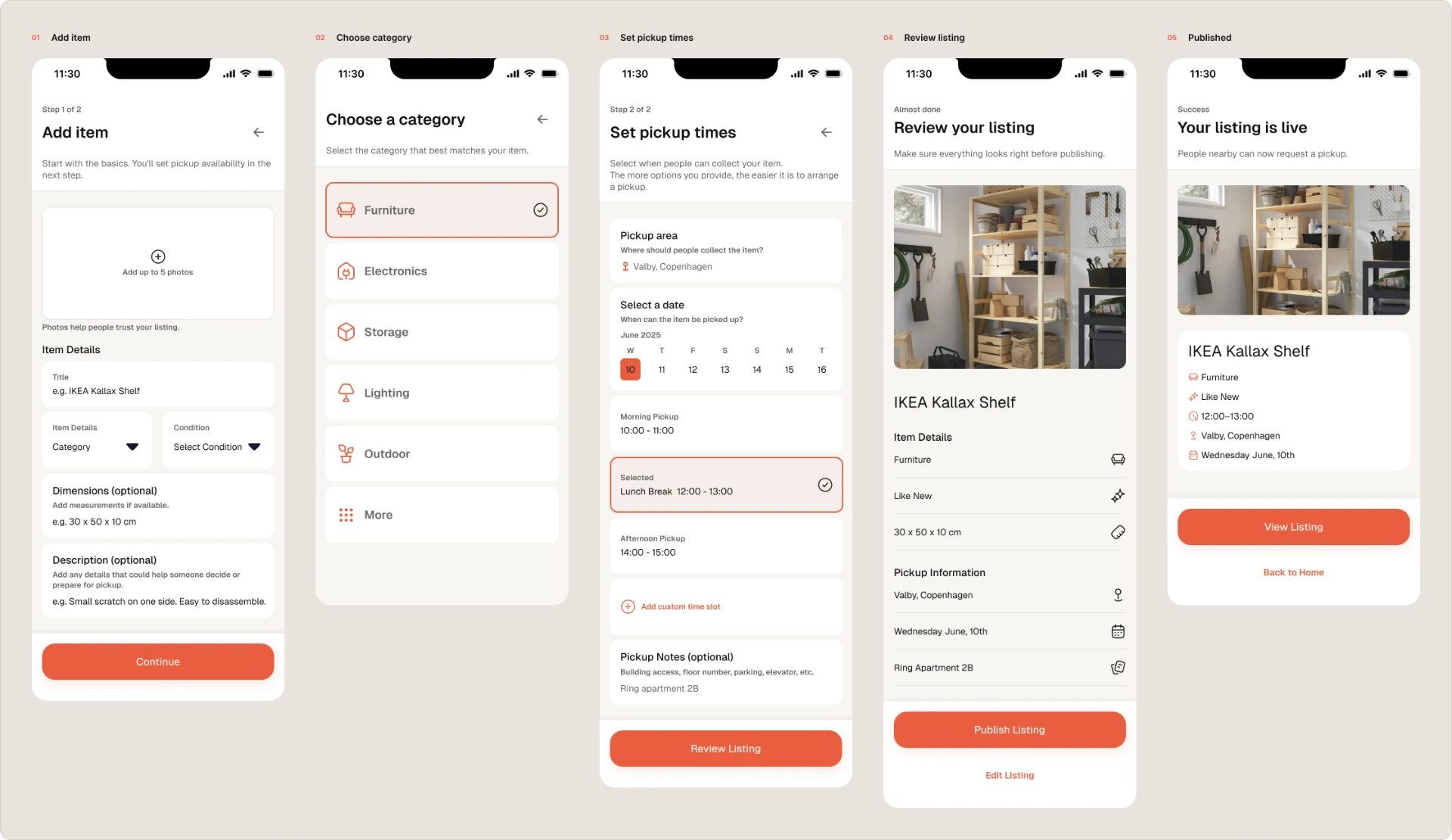
The solution puts pickup scheduling inside the product instead of leaving it to the chat. Two flows carry the core experience, and publishing stays as a wider concept exploration.

01

Discovery Flow

Browse nearby furniture and quickly understand what is available.

02

Pickup Coordination Flow

Choose a pickup time, send the request and follow its status through completion.

03

Publishing Flow

Concept exploration

I also explored how someone could publish an item. This flow sits outside the core prototype.

10High-fidelity prototype

From discovery to a completed exchange.

The final prototype focuses on the part of the experience where existing marketplaces often create the most friction: agreeing on a pickup, knowing what happens next and closing the exchange with clear feedback.

View interactive prototype

Try the core flow from finding the chair to completing the exchange and leaving a review.

  1. Discover
  2. Schedule
  3. Confirm
  4. Complete
  5. Feedback
FS.dk prototype screen: 02 — Home

Discover

02 — Home

Nearby furniture stays familiar and easy to browse.

FS.dk prototype screen: 03B — Pickup selected

Schedule

03B — Pickup selected

Choose a day and pickup time before sending the request.

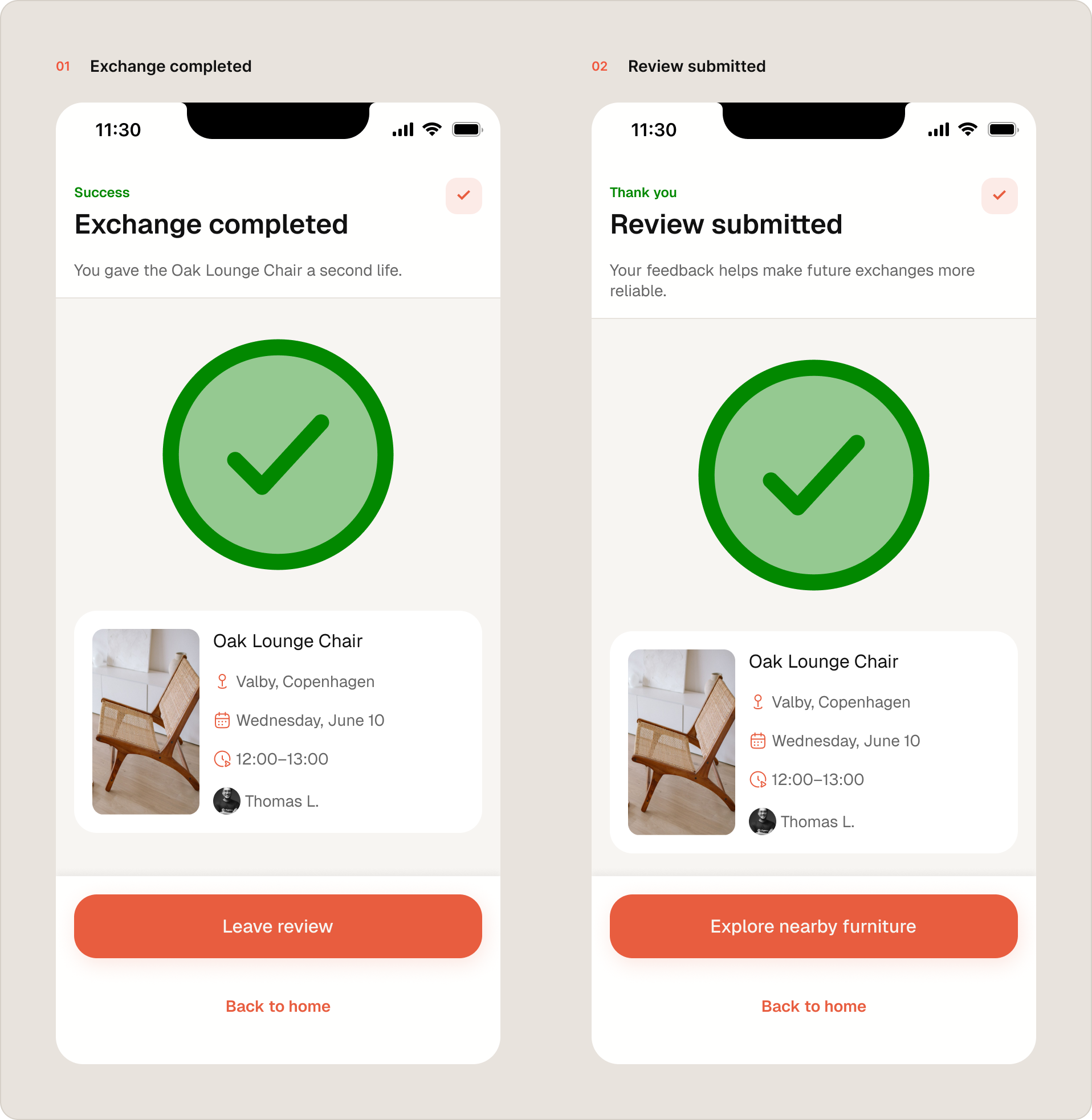
FS.dk prototype screen: 07 — Exchange Completed

Complete

07 — Exchange Completed

A clear completion state confirms that the exchange is finished.

FS.dk prototype screen: 09 — Review Submitted

Build trust

09 — Review Submitted

Feedback becomes part of the exchange and helps future users know who they are dealing with.

11Designed outcomes

What the design aims to improve.

This is a concept, so there are no production metrics. These are the changes the design is meant to create, and what I would want to test with real users.

Less effort

Less time spent coordinating

Picking a time inside the flow is designed to reduce the back and forth needed to arrange a pickup.

More clarity

Clearer expectations

Both people can see what was agreed and what happens next.

More trust

More trust between neighbors

Profiles, completed exchanges and reviews make people easier to read.

12What's next

What I would test next.

If this concept moved into validation, these would be the next hypotheses to test.

01

Commitment

Does a clearer commitment step reduce no-shows?

02

Reminders

Does the timing of a reminder change whether people show up?

03

Trust signals

Which signals actually make people feel comfortable meeting a stranger?

04

Calendar

Does connecting a calendar make picking a time easier or heavier?

13Trade-offs

What I chose to leave out.

Every decision leaves something behind. These are the ones that shaped the final experience.

Trade-off 01

Decision

Focus on pickup coordination instead of chat.

What was sacrificed

The flexibility people are used to when messaging freely.

Why it was the right decision

Choosing a time inside the product creates a clearer commitment and reduces the coordination needed in open chat.

Trade-off 02

Decision

Keep pickup coordination simple and structured.

What was sacrificed

More flexible scheduling options and open-ended messaging.

Why it was the right decision

The concept prioritizes a clear path from choosing a time to confirming the exchange.

Trade-off 03

Decision

Design for one city first.

What was sacrificed

Multiple regions, languages and wider reach.

Why it was the right decision

Staying local kept pickups realistic and let the concept solve trust and logistics properly.

14Reflection

The real problem was coordination, not discovery.

The visible problem is rarely the real one. There was no shortage of furniture to give away. The difficulty started after two people matched, when they had to agree on a time and actually meet.

The main thing I would validate is whether choosing a pickup time inside the product is enough to reduce no-shows, or whether it needs something extra like a reminder or a small reputation signal.

If the project continued, I would work on what happens after the pickup: confirming the exchange, reporting a bad experience and handling reschedules. Those quiet flows are where trust is built or lost.

I now spend more time understanding the real problem before designing screens, and I am more careful about working on the flow that looks obvious instead of the one that decides whether the product works.

Explore the prototype

View interactive prototype